Breed Standard
COTSWOLD BREED STANDARD
Size
A mature ram will weigh 250 to 275 pounds. A mature ewe will weigh 200 to 250 pounds.
Head
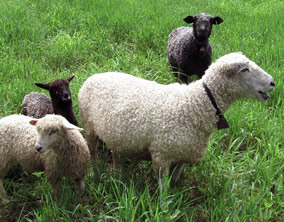
The head in the case of both the male and female is hornless. The poll is surmounted by curling locks of wool that often almost cover the eyes and extend down as far as the nostrils. This forelock is one of the characteristic features of the breed and is not trimmed when the sheep are shorn or trimmed for show. The nostrils should be wide and expanded. The nose should be dark.
Ears should be long but not heavy, carried well up, covered with silky hair. Black spots on the points of the ears are not considered objectionable.
Eyes should be full, dark and prominent.
Face can be open or closed with wool tufts on the cheeks.
Neck and Body
The neck should be relatively short and thick blending smoothly into the withers. The chest should be deep and broad with good width between front legs.
The back should be broad and level. The loin should be long blending smoothly with hips with deep well-sprung rib and good leg of mutton. Top line is straight with no drop in front or behind shoulders. The ribs should be quite full, not showing hollow behind the shoulder from which the ribs must spring with a fine circular arch. Belly should be straight on underline.
Breast should be broad and well forward, keeping the legs wide apart. Rump should be carried out on a level with the back, giving the animal a square looking frame.
Legs are medium length, straight, strong and must stand up straight on pasterns. Legs should be wide apart on each corner. Hooves must be black.
The whole body should have a firm, solid touch (not loose and flabby) and be well covered with thick set, long and lustrous wool.
Fleece
The fleece should be uniform, long and lustrous with average growth rate of one inch per month. Cotswold fleeces should grade from 42 to 48 and should hang in lock formation. Yolk of the fleece is moderate, preferably light to creamy in color.
Colored Cotswolds will exhibit all colors from jet black to white silver-gray with all combinations between.
Characteristics that are acceptable but not preferable for white Cotswolds:
Smutty face
Dappled tan, gray, brown or black on the legs
Undesirable characteristics:
Dropped pasterns
Drooping lower eyelids
Inverted eyelids
Pigeon toes
Small, loosely attached scurs
Any physical deformity
Registration guidelines:
White animals can include smutty face, dappling tan, brown and gray on the legs below the hock. No colored fibers in the fleece.
Colored animals would include coloring (black, silver or gray) in the fleece above the hock.
Tattoo of the registration number in the ear is required.
The following description of the “IDEAL COTSWOLD” is published annually by the British “Cotswold Sheep Society” in its flock book.
THE IDEAL COTSWOLD
This description of an ‘IDEAL COTSWOLD’ was written in 1891 by Mr W.S. Harmer of Cirencester. It is still adopted today as the Society breed and show standard.
The Head should be wide between the eyes, and the eye itself, full, dark, and prominent, but mild and kindly, and in no way coarse about the brow. The face should be proportionately wide to the space between the eyes, but not too flat, and should run of much the same width to the nostrils, which must be well expanded and somewhat broader than the face, with the skin on the nose of a dark colour. The cheek is full, and, as is the face, well covered with white hair; a just perceptible blue tinge on the cheek and around the eyes being rather ‘fancied’. The ear, long, but not heavy, of medium thickness, and covered with the same short soft hair, should be carried well up, while black spots on the point of the ears are not considered objectionable.
The top of the head should not be coarse or bald, but covered with wool, not hair, and the Cotswold is to be distinguished by a fine tuft of wool on the forehead. The head should be sufficiently long to save it from being called short and thick, but it should not have a long, lean appearance.
Grey faces still crop up occasionally in all the best hill flocks.
The Neck should be big and muscular, and should be gently curved to enable the sheep to carry the head well up, thereby giving the animal a grand appearance. The neck should be slightly smaller at the ears than where it comes from the shoulders.
The Shoulder should lay well back, and the point of the shoulder should be well covered with flesh, as also the chines.
The Ribs should be deep, well sprung from the back.
The Rump should be carried out on a level with the back, giving the animal a square looking frame.
The Leg of mutton well let down to the hock, and thick on the outside. The legs both front and hind, should be straight, moderate in length, well set outside the body. The pastern joints, both front and hind, should be short.
The whole body should have a firm, solid touch (not loose and flabby), and be well covered with thick set, long, and lustrous wool.